
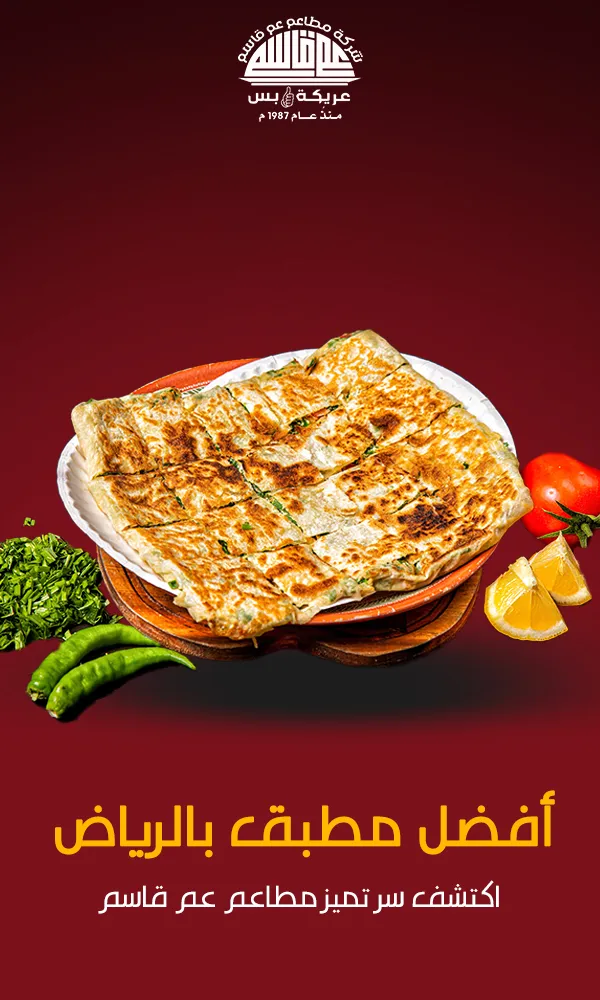
How to judge mutabbaq by eye
Before you taste, look. Good mutabbaq has thin, distinct layers and a golden colour that isn’t completely even — some lighter patches, some darker. A poor one is thick with a single flat colour, which means the dough wasn’t stretched enough.
The secret of the translucent dough
Mutabbaq dough is stretched in successive stages until it’s so thin that light passes through it. It’s a step that needs time and an experienced hand, and it’s the first thing cut short under pressure. The direct result of cutting it: a heavy mutabbaq that soaks up oil instead of crisping.
Warm filling, not hot
The filling goes in warm, not hot. A hot filling releases steam inside the folded dough and soaks it from the inside, so the mutabbaq comes out soft in the middle however crisp it is outside.
Oil: the variable that decides everything
After the dough, oil is the second factor. Mutabbaq is fried on a saj with a thin layer of oil, not deep-fried, and the saj needs a steady heat. A saj that’s slightly too cool means the dough absorbs oil before it browns, so the mutabbaq comes out greasy and heavy. A saj that’s too hot burns the surface before the inner layers cook.
There’s a simple sign you can notice as a customer: good mutabbaq doesn’t leave a big oil stain on the paper it’s wrapped in. A wide stain means the heat wasn’t right, or the oil has been used too long.
How to spot tired frying oil
Oil that’s been used again and again turns mutabbaq an uneven dark brown and leaves a heavy aftertaste that lingers after eating. It’s what separates a kitchen that changes its oil on a fixed schedule from one that puts it off. In our kitchens, the saj oil is changed on a fixed daily schedule that doesn’t depend on how many orders came in that day.
Our kinds of mutabbaq
The menu has eleven kinds, savoury and sweet. Savoury includes Am Qasim Mutabbaq, tuna, and cheese four different ways. Sweet includes cream, banana, qishta and sweet cheese. Prices start at seven riyals, and it’s our best item for a quick order.
Mutabbaq in Riyadh: a different market from Jeddah
Mutabbaq in Riyadh has a different character from the coastal cities. Demand here leans towards savoury rather than sweet, and takeaway volume is much higher, because the way people get around Riyadh makes a quick pickup more convenient than sitting down. That’s why most mutabbaq kitchens in Riyadh are built for speed — and that’s exactly where the risk of cutting the stretching step shows.
Anyone searching for “the best mutabbaq in Riyadh” is really looking for a kitchen that hasn’t compromised on this step despite the pressure. And that’s something you can check for yourself: ask whether the dough is stretched to order or prepared in advance.
Savoury or sweet?
Savoury is the usual choice for a meal, while sweet is mostly ordered at the end or with tea. The practical rule if you’re ordering more than one: start with savoury and finish with sweet, and don’t mix them in the same order if you’ll be waiting — sweet loses its crunch faster because of the moister filling.
Our most ordered savoury kind is tuna mutabbaq, followed by two-cheese. Among the sweet ones, cream and banana are clearly ahead of the rest.
If you’re ordering for a group, the usual rule is two pieces per person if mutabbaq is the main dish, and one if it’s alongside another dish. Mutabbaq is usually cut into four pieces when served, which makes it better for sharing than any other item on the menu.
Mutabbaq and calories
Mutabbaq isn’t the highest-calorie item on our menu, but it varies a lot from one kind to another. Vegetable mutabbaq is the lightest, and mutabbaq with cheese and cream is the heaviest. The calories are written on every item on the menu so you can compare before ordering — something you won’t find at most mutabbaq restaurants.
Where in Riyadh?
At the Tuwaiq branch there’s an open mutabbaq corner where you can watch the dough being stretched and filled in front of you — the clearest proof that the step hasn’t been cut. And the Tuwaiq branch and the Laban branch both offer direct ordering from the website if you prefer pickup or delivery.
When to eat mutabbaq
Straight after frying. Mutabbaq loses half its value if it waits ten minutes. If you’re ordering delivery, order it with items that hold up while waiting, such as masoub, and eat the mutabbaq first.